ExoHub: Distributed Data Management Using Git-Based Principles
Table of Contents
Executive Summary
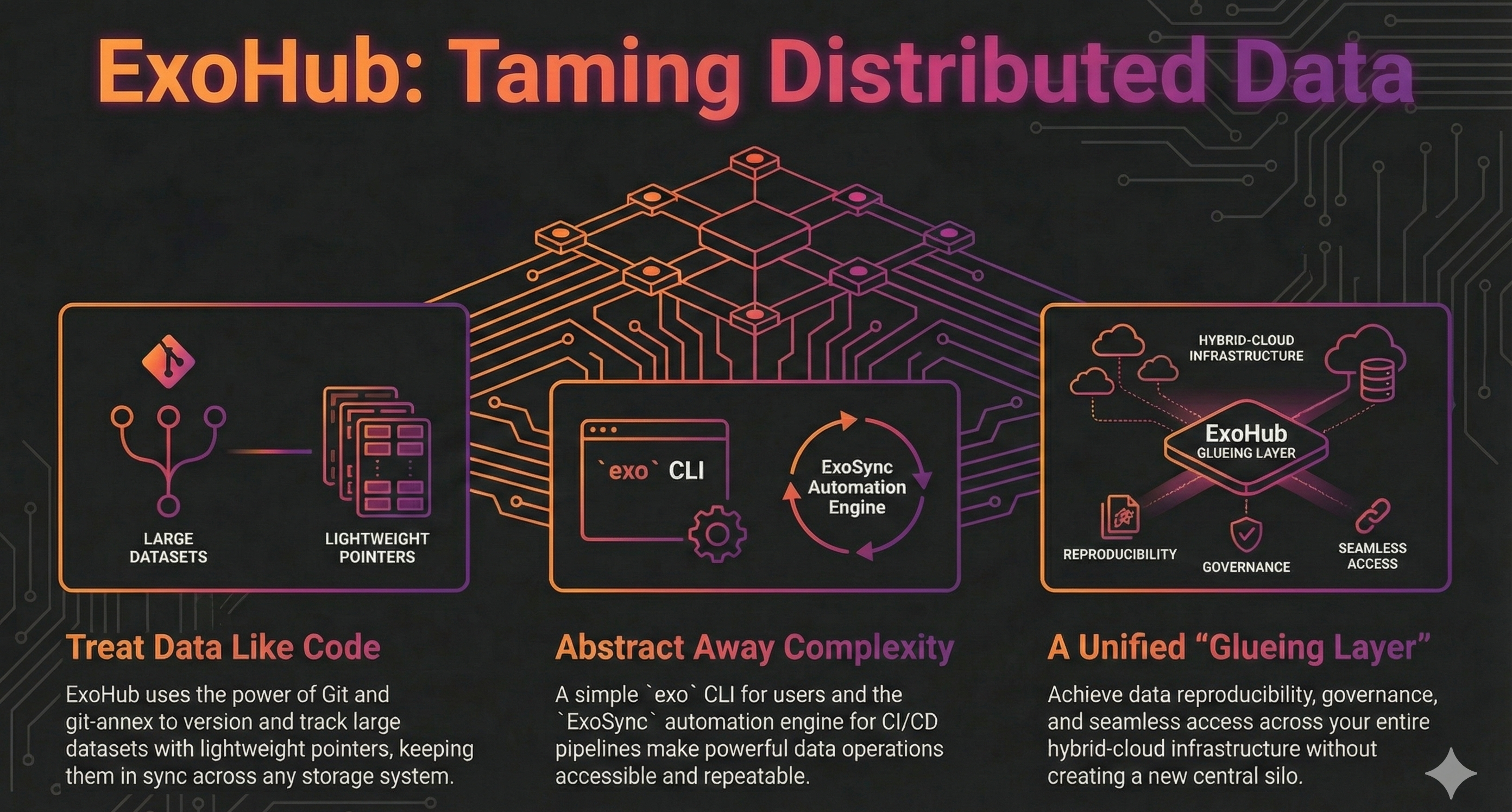
ExoHub is a technical framework designed to resolve the fragmentation and synchronization issues inherent in modern, distributed data environments by treating data with the same rigor as source code. The architecture utilizes git-annex as a foundational layer, allowing large datasets to be versioned and tracked via lightweight pointers while the actual files remain stored across diverse backends like cloud object stores and on-premises high-performance computing systems. To overcome the steep learning curve of its underlying tools, the system introduces an abstraction layer consisting of a simplified command-line interface and a resilient orchestration engine called ExoWorkers for automating complex workflows. Ultimately, the project serves as a standardized gluing layer that ensures data reproducibility, governance, and seamless access across hybrid-cloud infrastructures without requiring a new centralized silo.
1. The Challenge of Modern Data Ecosystems
Modern data management is defined by the complexity of hybrid environments, where data assets are distributed across a mix of on-premises high-performance computing (HPC) filesystems, cloud object stores, and collaborative platforms. This operational reality presents significant architectural challenges that manifest as data fragmentation, desynchronization, and the proliferation of disconnected catalogs. This section will diagnose the root causes of these issues, establishing the critical need for a new architectural approach to bring order to this inherent chaos.
The symptoms of a fragmented data landscape are familiar to most data-driven organizations. These challenges do not arise from a flawed strategy but from the natural, agile way teams work, adopting tools and storage solutions that best fit their immediate needs. The fragmentation itself is not inherently problematic; the core issue stems from the lack of a formal monitoring and tracking layer to manage data as it moves and evolves across these disparate locations. This leads to systemic issues:
- Unsynchronized Duplication: Data is frequently copied to different locations for convenience or performance, but these copies quickly fall out of sync. Without a formal tracking mechanism, it becomes impossible to determine which version is the canonical source of truth.
- Access Complexity: Data is spread across a heterogeneous collection of storage backends, including cloud services like AWS S3 and Google Drive, as well as on-premises sHPC filesystems. Accessing this data requires navigating a maze of different clients, credentials, and network pathways.
- Catalog Desynchronization: In an attempt to track data, organizations build catalogs. However, when a catalog describes data residing in a location not under its direct control, it creates a significant risk of desynchronization. The data can change, rendering the catalog’s metadata outdated, irrelevant, or dangerously incorrect.
This messy situation, characterized by disconnected communication channels and untracked data forks, makes governance, reproducibility, and collaboration nearly impossible. The core philosophical stance of the ExoHub project is that the solution does not lie in building another centralized system. Instead, the answer is to create a standardized, extensible gluing layer built upon proven, universally adopted standards. This approach provides a common framework for tracking, synchronizing, and managing data, regardless of where it lives.
2. Foundational Principles: Treating Data as Code with git-annex
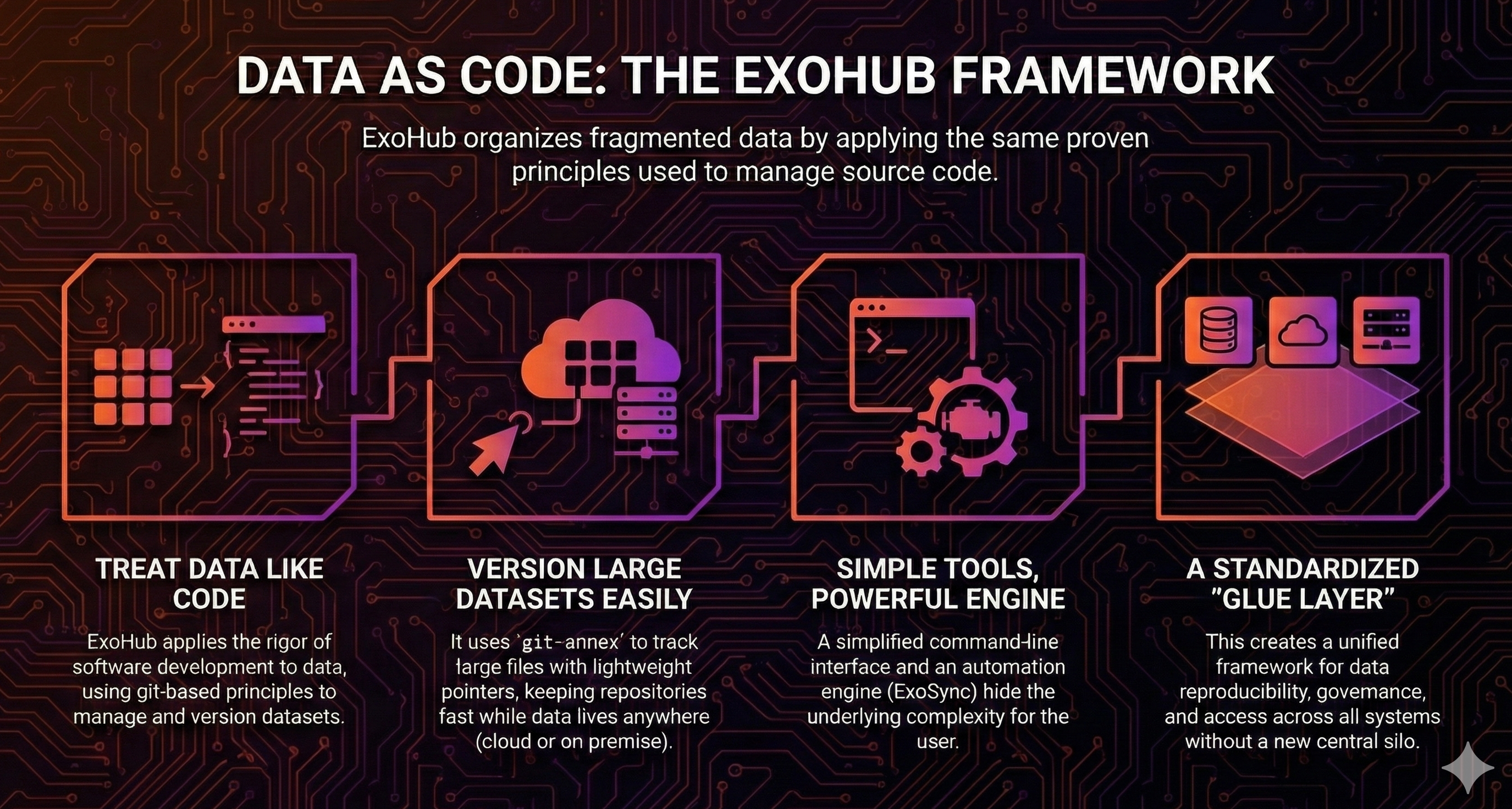
The strategic foundation of ExoHub is the adoption of proven software engineering principles for data management. For decades, the problem of managing, versioning, and collaborating on complex digital assets has been elegantly solved for source code. The core concept is to treat data with the same rigor as code, and git has emerged as the ubiquitous, undisputed standard for this paradigm. By leveraging git, we can build upon a tool that is already a daily fixture for nearly every technical professional.
While git excels at tracking text-based source code, it is not designed to handle the large binary files typical of scientific datasets. The technical rationale for choosing git-annex as ExoHub’s foundational technology is that it directly solves this limitation without sacrificing the distributed power of git. git-annex works by “annexing” large files: it moves the file content to an external storage location and replaces it in the git repository with a lightweight pointer (a symlink). This pointer is then tracked by git, allowing the full history of the data to be versioned without bloating the repository itself, using a powerful concept of “special remotes” to connect to to a diverse array of storage backends, from cloud object stores like S3 and Google Drive to on-premises filesystems.
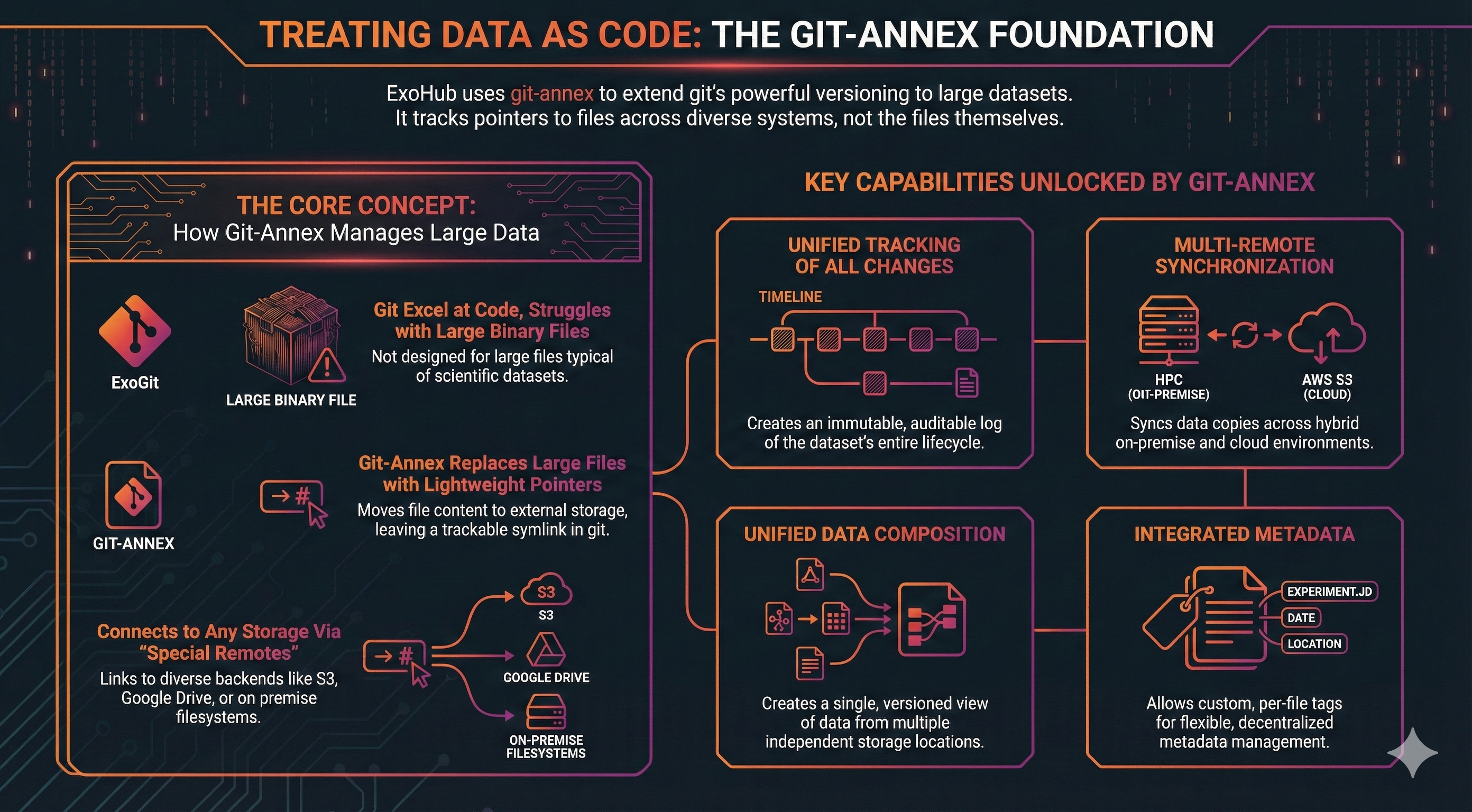
The git-annex approach provides a rich set of features that form the bedrock of the ExoHub architecture.
- Unified Tracking: Every change to the dataset—from modifying a single data file to updating metadata tags—is tracked in the git history. This provides an immutable, auditable log of the dataset’s entire lifecycle, capturing not just major releases but any tiny change worth tracking.
- Multi-Remote Synchronization: git-annex is designed for a distributed world. It allows multiple remotes to be configured for a single repository, enabling robust synchronization of data copies across hybrid on-prem (sHPC) and cloud (AWS S3) environments. This capability is essential for creating geolocated caches and ensuring data consistency across disparate storage systems.
- Data Composition: Assembling datasets from files stored in different locations is a common challenge. git-annex formalizes this process by allowing a single project to track pointers to data residing in multiple, independent storage backends, creating a unified and version-controlled view of a composite dataset.
- Integrated Metadata: Beyond the rich metadata inherently captured by git (author, timestamp, commit hash), git-annex allows for custom, per-file tags. This simple key-value system provides a flexible, decentralized way to embed technical metadata directly with the data it describes, which can be used to drive synchronization rules or feed a higher-level data catalog.
- External System Integration: Through the “external special remote” protocol, git-annex enables the implementation of custom remotes, providing a robust integration layer to normalize access and connect the architecture with diverse internal and legacy systems.
- Workflow Automation: Because git-annex is fully integrated with git, it can leverage the entire git ecosystem for automation. Git hooks (e.g., pre-commit) can enforce data governance rules, and structured commit messages (like conventional commits) can be used to automate data versioning and record formal provenance information.
In summary, git-annex provides the powerful, distributed, and extensible foundation required for the ExoHub architecture. However, its comprehensive feature set comes with a steep learning curve. This complexity necessitates a carefully designed abstraction layer to make its power accessible to a broader audience. The following section details the ExoHub components that provide this crucial abstraction.
3. The ExoHub Architecture: A Component-Based Overview
ExoHub is the architectural implementation of the “data as code” philosophy, designed to serve as a user-friendly and robust orchestration layer on top of the powerful git-annex foundation. The system is not a monolithic application but a collection of cohesive components that work in concert to abstract complexity and automate sophisticated data management workflows. This section dissects the core components of the ExoHub architecture, explaining how they provide a unified interface for managing distributed data.
The high-level system architecture enables the creation of a logical project that serves as a single, version-controlled entry point to data that may be physically scattered across the enterprise. This unified view can compose data, tags, and metadata from disparate storage locations, including multiple AWS S3 buckets, Google Drive, public HTTP servers, and on-premises sHPC filesystems.
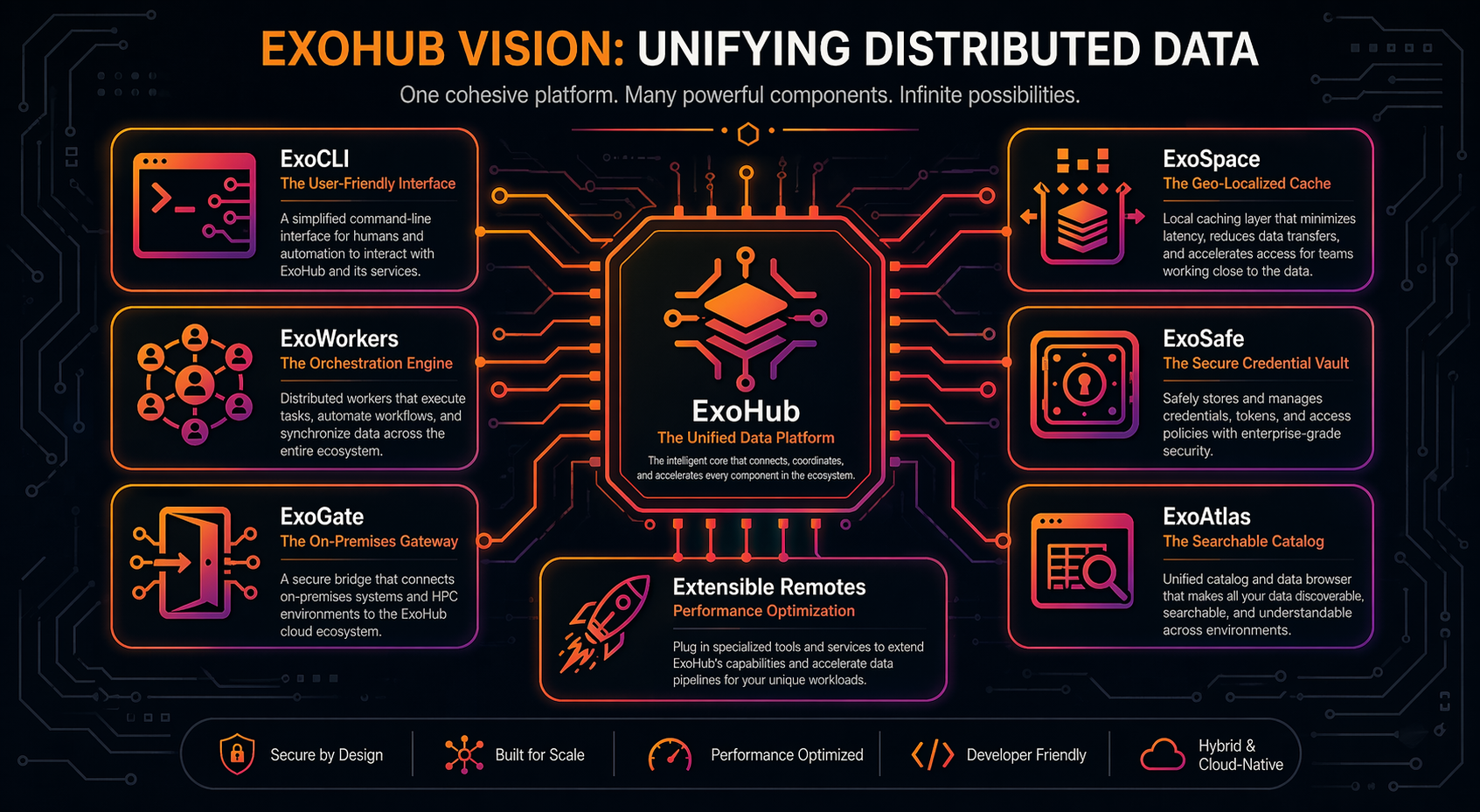
The system is composed of several primary components, each with a distinct role:

exoCLI: This command-line interface is the primary entry point for developers, data scientists, and automated agents. Its fundamental purpose is to abstract the inherent complexity of git-annex. Instead of requiring users to learn the extensive git-annex command set, the exo CLI provides simple, high-level commands such as pull, export, copy, sync, and broadcast. It introduces the use of declarative YAML manifests, allowing complex, multi-step data operations to be defined, version-controlled, and executed in a repeatable manner. Additional specialized commands exist to support the orchestrated workflows detailed in Section 4.0. ExoWorkers: This is the system’s resilient orchestration engine. Implemented as a Temporal
Worker, ExoWorkers are responsible for executing long-running, fault-tolerant data workflows. It
automates tasks like synchronizing large datasets between on-premises and cloud environments or
mirroring data for local processing. By leveraging Temporal, ExoWorkers ensure that these critical
data operations are durable and can recover from transient failures, which is essential in a
hybrid-cloud environment.
 ExoGate: This component serves as the on-premises gateway, bridging the gap between cloud-based
infrastructure and protected local resources. ExoGate runs on-premises and allows cloud-native
ExoWorkers to securely interact with high-performance filesystems like sHPC HPFS. This
component directly solves the “Access Complexity” problem identified earlier by creating a secure,
automated bridge for cloud-based orchestration to interact with on-premises data, eliminating the
need for users to navigate complex network pathways and credentials for sHPC filesystems.
 ExoSpace: This git-annex remote acts as a first-line caching area, situated locally to the
specific compute environments (e.g., sHPC) where datasets are created and accessed by a common set
of users. It serves as the local source of annexed data for cloud synchronization, which ExoGate
orchestrates via ExoWorkers. Crucially, it functions as a geo-localized cache, preventing excessive
upload/download traffic between on-premises and cloud, which would otherwise occur when a user
uploads a new dataset only for another user in the same location to immediately download it. It
can also be used in preemptive caching scenarios to accelerate data access.
 ExoSafe: This component provides a cloud-backed vault for the git credentials that users and
automated systems need in ephemeral environments. By storing SSH keys and tokens in a typed,
centrally managed store and provisioning them during login, ExoSafe removes a major source of
friction in hybrid workflows while preserving secure, auditable access to repositories.
 ExoAtlas: This component is the discovery and browsing layer for published datasets and
artifacts. It gives users a searchable catalog experience, available both as the interactive
exo atlasterminal interface and as a browser-based web application, making distributed data assets easier to find, inspect, and retrieve across environments.- Extensible Remotes: The architecture is designed for extensibility. Key examples include the
custom git-annex-remote-s5cmd, a special remote written in Go that integrates the high-performance
s5cmd tool for parallelized S3 transfers, and the
artifactdbremote type, which publishes the generic and technical metadata produced byexo bundleinto the multi-tenant ArtifactDB ArtifactDB catalog. Together, these integrations demonstrate the system’s ability to incorporate specialized, best-of-breed tools to optimize performance and metadata publication for specific backends.
Together, these components form a synergistic system that simplifies and automates distributed data management. The exo CLI provides an accessible interface for users, while ExoWorkers, ExoGate, ExoSpace, ExoSafe, ExoAtlas, and extensible remotes provide the robust backend and access layers for orchestrating complex workflows. The following section will demonstrate how these components are utilized in practical, end-to-end scenarios.
4. Core System Workflows in Action
The true power of the ExoHub architecture is realized through its operational workflows, which translate its foundational principles into practical, repeatable data management patterns. These workflows cater to two primary modes of operation: an interactive, CLI-driven mode for developers and data scientists working on local machines, and an automated, orchestrated mode for large-scale, CI/CD-integrated data synchronization.
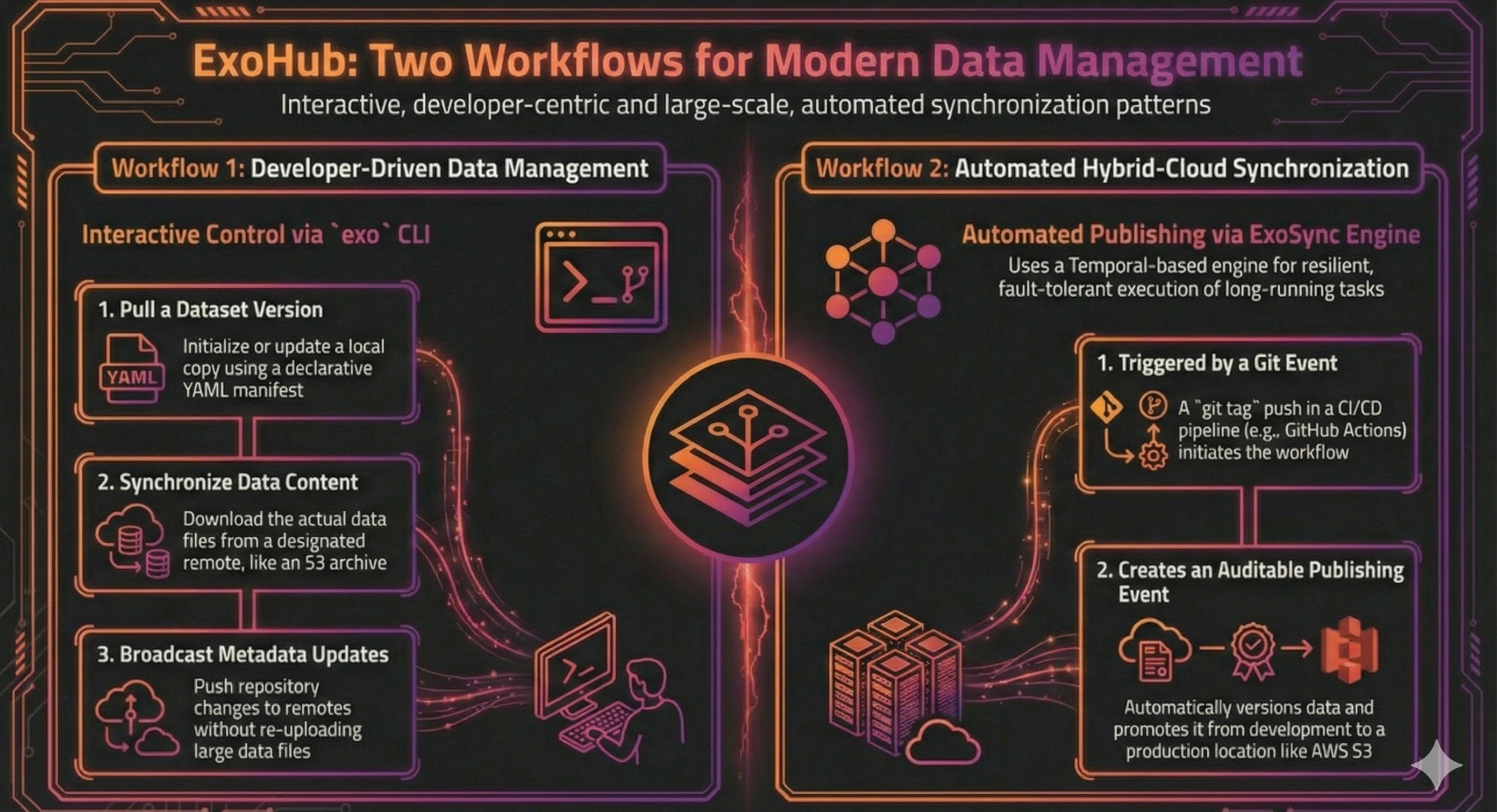
Workflow 1: Developer-Driven Data Management (exo CLI)
For users who need to interactively explore, modify, and version datasets, the exo CLI provides a streamlined and powerful interface. A typical workflow involves using simple commands in conjunction with declarative YAML manifests to ensure operations are repeatable and version-controlled. A developer wanting to refresh a local dataset, sync it with an S3 remote, and then broadcast the metadata changes would follow these steps:
- Pull a specific version of the dataset. Using a manifest that defines the repository URL and the target version tag, the developer initializes or updates their local copy.
- Synchronize data content. The developer then uses a sync manifest to download the actual data files for specific paths from a designated git-annex remote, such as an S3 archive. The manifest allows for precise control over which parts of the dataset are materialized locally.
- Broadcast metadata updates. After making local changes and committing them, the developer can update other remotes with the latest metadata (the state of the git repository) without transferring any large data files. This manifest-driven approach ensures that even complex data wrangling tasks are documented as code, can be shared among team members, and are easily integrated into larger scripts.
Workflow 2: Automated Hybrid-Cloud Synchronization (ExoSync & Temporal)
For large-scale, automated data publishing and replication, ExoHub relies on ExoSync, its Temporal-based orchestration engine. This workflow is designed for integration into CI/CD pipelines and provides resilient, fault-tolerant execution of long-running data transfers.
- ExoSyncWorkflow: This is the primary workflow for publishing and replicating datasets between different storage environments. A common use case is a CI/CD pipeline triggered by a git event. For example, a git tag push to a repository can trigger a GitHub Action. This action, in turn, invokes the ExoSyncWorkflow, which annexes the newly tagged data and synchronizes it to a production AWS S3 bucket. This pattern creates a fully automated, auditable “data publishing” event, where a versioned dataset is promoted from development to a production location.
- ExoExportWorkflow: If the data stored on S3 needs to be accessed by third-party downstream
consumers (e.g., direct S3 access), the ExoExportWorkflow replicates a tree on a
filesystem to S3, similarly to what
aws s3 syncwould produce. The full history and versions of the assets are lost in favor of an easy-to-access snapshot of the data, equivalent to a release extract from the git repository.
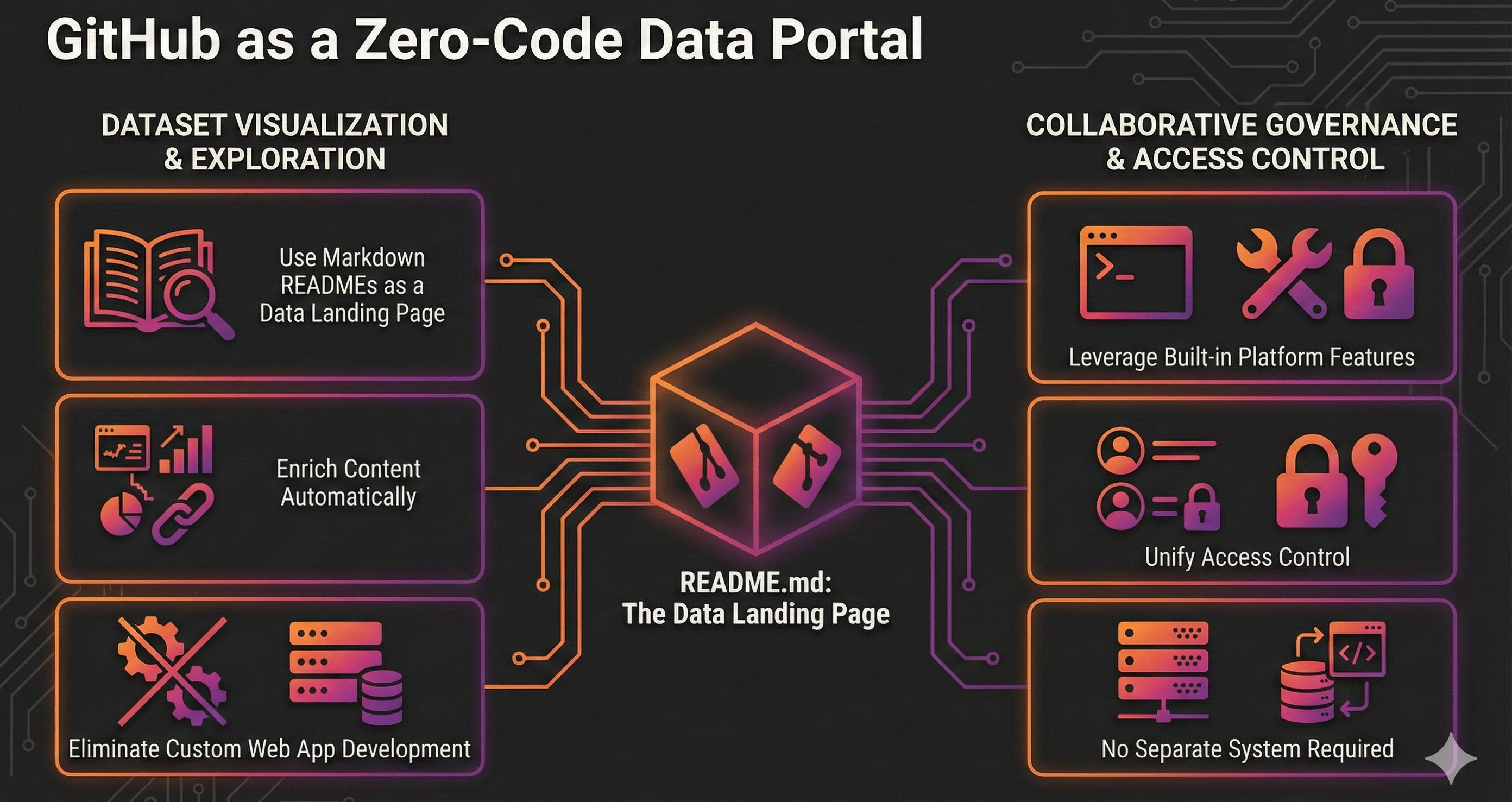
5. GitHub as a Data Portal
A key consideration for the ExoHub Portal is avoiding the cost and complexity of custom web application development for basic data exploration. By leveraging the universal adoption of GitHub/GitLab and Markdown-based READMEs, ExoHub can provide an efficient, zero-maintenance solution for basic dataset visualization and overview. A well-constructed README, enriched with automatically generated tables and static visualizations, links, screenshots, badges, can serve as the primary landing page for a dataset. Furthermore, the git hosting platform itself, such as GitHub, already provides robust, built-in features for collaborative data governance and access control, allowing administrators to manage user and team permissions directly against the versioned data repository without needing a separate system.
6. Implementation Considerations and Scalability
While the ExoHub architecture provides a powerful solution for distributed data management, any robust system design involves trade-offs and practical challenges. A transparent analysis of these considerations is essential for successful implementation. This section provides a balanced overview of potential hurdles related to usability, performance at scale, and dependencies, along with the mitigating strategies employed by the ExoHub architecture.
git-annexComplexity: The single greatest risk is the steep learning curve of the underlying git-annex technology. Its feature-rich nature makes it complex for newcomers.- Mitigation: ExoHub addresses this directly by abstracting all common user interactions through the simplified exo CLI and fully orchestrated Temporal workflows. End-users are intentionally shielded from git-annex internals, allowing them to benefit from its power without needing to master its complexity.
- Scalability: Managing extremely large datasets raises valid performance questions,
particularly around the time required to hash large files and the limits of git hosting platforms.
- Mitigation: Real-world examples from similar systems like Datalad demonstrate the viability of this approach at scale, with documented use cases of datasets up to 500TB containing millions of files. While git hosting platforms can have repository limits, this is a manageable constraint; repositories can be hosted on-premises or even stored as bundles in object storage, as a central git server is not strictly required.
- Authentication: A distributed system that connects to multiple, heterogeneous remotes (AWS
S3, Google Drive, git servers) introduces the “authenticating thunder” problem, where users or
systems must manage a complex web of credentials.
- Mitigation: While a comprehensive solution remains a challenge, services like OIDC provide a normalization layer for accessing AWS resources, simplifying credential management for a significant portion of the cloud ecosystem.
- Toolchain Dependencies: git-annex is written in Haskell, which is not a common enterprise
language and can present a deployment challenge.
- Mitigation: This dependency is managed by controlling the toolchain and compiling git-annex into static binaries. This approach, also used by projects like Datalad, ensures that the tool can be deployed reliably across different platforms (e.g., in Docker containers or on sHPC systems) without requiring a complex runtime environment.
These challenges are acknowledged as real but are ultimately positioned as manageable engineering problems. Through thoughtful architectural design—specifically the use of abstraction layers, workflow orchestration, and controlled dependencies—ExoHub effectively mitigates these risks to deliver a scalable and usable system.
7. Conclusion: A Gluing Layer for Decentralized Data
ExoHub presents a paradigm shift into “treating data like code” by applying industry-standard, git-based workflows and principles. It provides a robust, flexible, and extensible gluing layer designed to bring coherence to the inherently distributed and fragmented nature of modern data ecosystems. Combining the universal principles of git, the distributed power of git-annex, and the resilience of modern workflow orchestration with Temporal, ExoHub offers a pragmatic and powerful solution to today’s data management challenges.
The architecture directly addresses the core problems of data fragmentation and desynchronization outlined at the start. Unsynchronized data copies are replaced with version-controlled, tracked remotes. Complex, multi-platform access is unified through a single, abstracted interface. The risk of stale metadata in disconnected catalogs is eliminated by embedding metadata with the data itself, managed under a single, auditable version history.
Ultimately, ExoHub champions the philosophy of treating data with the same rigor and proven tooling as source code. This approach establishes a foundation for a more agile, traceable, and decentralized data ecosystem, empowering organizations to manage complexity not by fighting it with yet another silo, but by embracing it with a common, standardized framework built for a distributed world.