Architecture
Pinard’s components communicate exclusively via NATS JetStream over WebSocket
(wss://). There is no direct HTTP between components — NATS is the single bus, which is
why an agent can run from any network (or another machine) with only outbound NATS.
Components
| Component | Code | Runs as | Model |
|---|---|---|---|
| Daemon | cmd/aoc/daemon.go | self-supervising background process | — |
| Régisseur | pi-extension/pinard/ | Pi extension, conductor tmux window [régisseur] | Opus |
| Maître | pi-extension/pinard/ (PINARD_PARCELLE set) | Pi extension, one tmux window per parcelle | Opus |
| Vendangeur (worker) | pi-extension/worker/ | spawned tmux session | Sonnet |
| CLI | cmd/aoc/ | Go binary (aoc) | — |
| Launcher | bin/pinard | shell script | — |
The daemon is always running; the régisseur/maîtres are optional LLM layers. See Orchestration & Parcelles for how the three conductor tiers relate.
The daemon
The daemon is the engine. Started with aoc daemon start, it re-execs itself detached
(no systemd), writes .state/daemon.pid, and logs to logs/aoc-daemon.log. It runs all
watchers as goroutines on one persistent NATS connection and handles:
- MR watching — pipelines, reviews, approvals, auto-merge, post-merge monitoring
- Issue watching — assignee detection and auto-spawn (every assigned issue)
- Schedule evaluation — cron spawns with backfill
- Direct dispatch — actionable events go straight to worker inboxes (no conductor needed)
- Liveness — orphan recovery and maître window recovery
Hot-reload is in-process: a tick polls the mtimes of the aoc binary, vignes.yaml,
and schedules.yaml, and execs itself in place on any change (same PID, same logs).
Communication
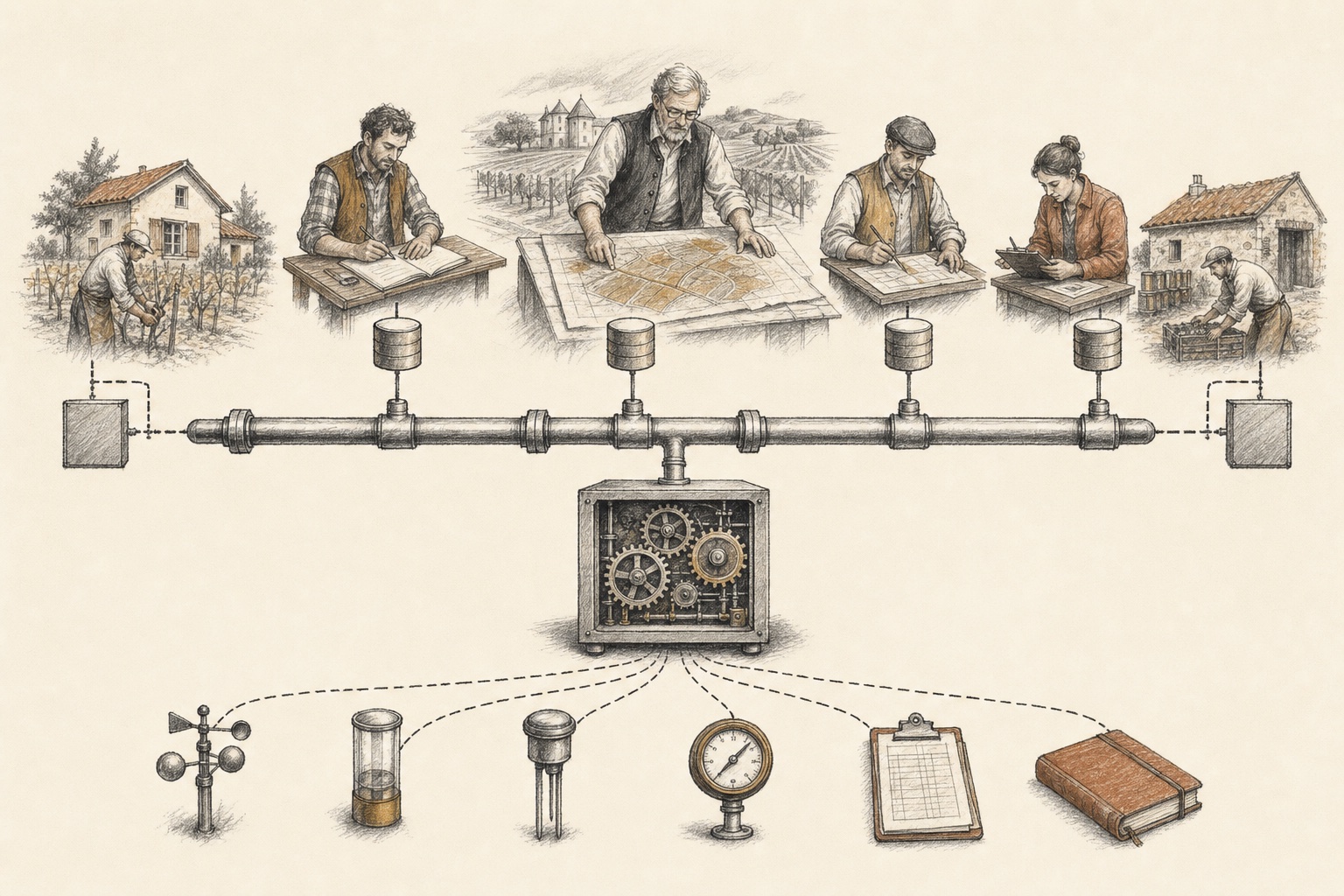 Régisseur & maîtres
Vendangeurs
Vendangeurs
NATS JetStream
Daemon
Watchers & persisted state
Régisseur & maîtres
Vendangeurs
Vendangeurs
NATS JetStream
Daemon
Watchers & persisted state- Régisseur & maîtres — optional LLM conductors above the bus.
- Vendangeurs — independent workers connected through NATS, never directly to one another.
- NATS JetStream — durable inboxes and events use the central bus.
- Daemon & watchers — issue, MR, schedule, dispatch, liveness, and state machinery.
- Broken terracotta routes — ephemeral core-NATS traffic such as BTW and interrupt.
Three channels (conductor → worker)
| Channel | Subject suffix | Transport | Purpose |
|---|---|---|---|
| Main inbox | …inbox | JetStream (durable) | Actionable work, queued until the turn ends |
| BTW | …btw | core NATS (real-time) | Parallel questions, immediate reply, no persistence |
| Interrupt | …interrupt | core NATS (real-time) | Cancel the current turn |
Events (worker / watcher → conductor)
Actionable events are dispatched by the daemon directly to the worker’s inbox; the
rest are informational (the conductor sees them for visibility). ACK_REQUIRED events
need a human/conductor acknowledgement.
| Event | Source | Dispatched to worker? |
|---|---|---|
pipeline_failed | MR watcher | Yes |
review_comment | MR watcher | Yes |
main_pipeline_failed | MR watcher | Yes |
tag_pipeline_failed | MR watcher | Yes |
mr_merged / mr_closed | MR watcher | No |
needs_approval | MR watcher | No (ACK_REQUIRED) |
circuit_breaker | MR watcher | No (ACK_REQUIRED) |
issues_new / issues_comment | Issue watcher | No |
schedule_spawned/skipped/failed | Scheduler | No (ACK_REQUIRED) |
agent_idle / session_ended | Worker | No |
NATS subjects
Agent subjects are parcelle-scoped — they carry a literal parcelles.<parcelle>
segment (a worker always has a parcelle, defaulting to its project). Vignoble-level
subjects (issues/schedules/notifications) are not parcelle-scoped.
pinard.<vignoble>.parcelles.<parcelle>.agents.<session>.events.<type>
pinard.<vignoble>.parcelles.<parcelle>.agents.<session>.inbox
pinard.<vignoble>.parcelles.<parcelle>.agents.<session>.btw
pinard.<vignoble>.parcelles.<parcelle>.agents.<session>.interrupt
pinard.<vignoble>.notifications
pinard.<vignoble>.issues.<new|comment>
pinard.<vignoble>.schedules.<name>.<status>
Subjects are built with centralized helpers (internal/pnats/subjects.go) — never
hand-formatted. A maître consumer filters to its own parcelle; the régisseur uses the
vignoble-level subjects plus a KV overview rather than the per-parcelle firehose.
tmux topology
One tmux server per vignoble (socket pinard-<vignoble>). The conductor session holds
the [régisseur] window plus one window per active parcelle maître. Vendangeurs are flat
tmux sessions on the same server, named parcelle-first (<parcelle>--<project>-<id>) so
the session list is self-describing and filterable.
Visual palette
The launcher applies a role-colored tmux palette on startup so each agent tier is visually distinct:
| Role | Surface | Color |
|---|---|---|
| Régisseur | conductor session base bar | Trellis grey; status-left shows 🍇 <vignoble> |
| Régisseur | [régisseur] tab | Burgundy — inactive: rosé text / grey; active: white on burgundy |
| Maître | Per-parcelle window tabs | Gold — inactive: gold text / grey; active: ink on gold |
| Vendangeur | Whole-session status bar | Leaf green, 🧺 vendangeur label |
Session/window pickers (ctrl+b s, ctrl+b w, ctrl+b f) are rebound to a colored
choose-tree that tints entries by role (🍷 conductor session, 🎩 régisseur window,
🧑🌾 maître windows, 🧺 vendangeur sessions), making the multi-tier layout easy to
navigate at a glance.
State
All state is persisted on every mutation (write-through, atomic rename, flock):
| File | Contents |
|---|---|
.state/mr-watcher.yaml | Watched MRs, pipeline counts, post-merge state |
.state/issue-watcher.yaml | Tracked issues, last note IDs |
.state/scheduler-runs.yaml | Last run timestamps per schedule |
.state/daemon.pid | Daemon PID (liveness via signal 0) |
Conductor and maître sessions are resumable Pi sessions
(.state/regisseur-session.jsonl, parcelles/<name>/session.jsonl).