The Layered Memory Architecture
Status legend: ✅ shipped · 🔭 designed · 🧪 spike (being de-risked). The engram capture-and-store surface described in Memory & Recall is shipped today. The layered architecture on this page is the design Pinard is building toward; treat 🔭 items as roadmap, not current behavior.
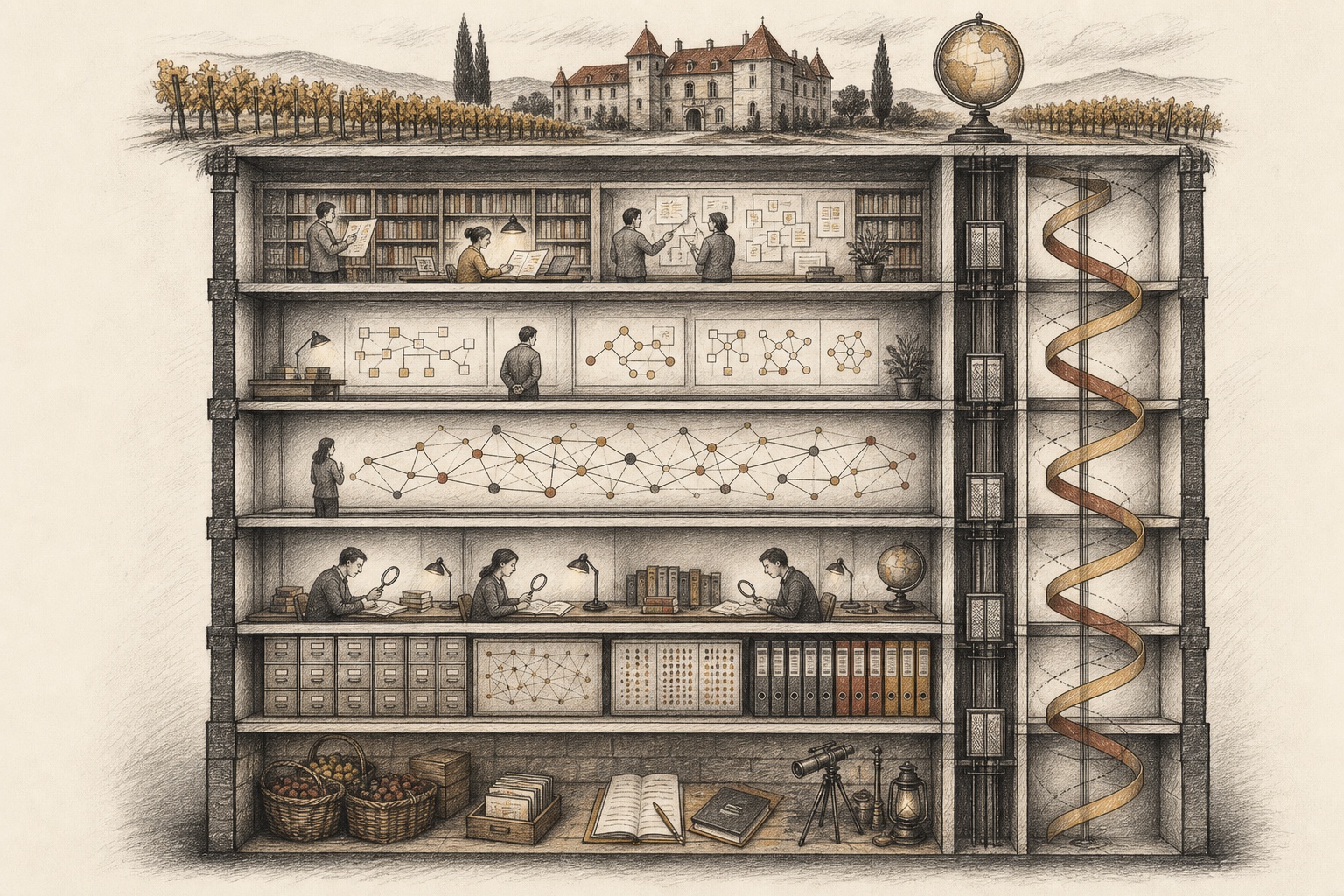
The memory layer is organized as a stack. Each layer has one job, and the layers above depend only on the interface below them — so any single layer can be swapped without breaking agents.
 L6 · Scope & promotion
L5 · Curation & wiki
L4 · Ontology
L3 · Knowledge graph
L2 · Recall
L1 · Store of record
L0 · Capture
Portability & embeddings
L6 · Scope & promotion
L5 · Curation & wiki
L4 · Ontology
L3 · Knowledge graph
L2 · Recall
L1 · Store of record
L0 · Capture
Portability & embeddings- L0Capture ✅ — curated lessons, teaching episodes, and passive observations enter through Engram.
- L1Store of record 🔭 — documents, graph edges, and vectors share one SurrealDB store.
- L2Recall ✅ — typed query/fetch intent and compact boot injection.
- L3Knowledge graph 🧪 — temporal graph value is evaluated before commitment.
- L4Ontology ✅ — declarative Go core ontology plus domain YAML extension — CLI:
aoc ontology validate/inspect. - L5Curation & wiki ✅ — a git-tracked, human-readable OKF artifact synchronized with the store.
- L6Scope & promotion ✅ — curated knowledge rises from vigne to vignoble to global.
The design through-line is signal over noise: capture curated knowledge instead of dumping transcripts, keep it in one multi-model store instead of a zoo of databases, and treat memory as a versioned, portable artifact you can ship with an agent.
Layer 0 · Capture — Engram (✅ shipped)
Knowledge enters through Engram, not raw transcripts. Three inputs:
/lesson <text>✅ — a one-shot pinned fact or rule, high-confidence and eligible for promotion (e.g. “always use afix:/feat:commit prefix”). Available in conductor and vendangeur./teaching✅ — a mode: while active (with a visible status-line indicator, auto-off at session end) the session is captured as ateaching-episode. Supports retroactive capture via--allor--from <duration>. Conductor only.- Passive capture ✅ — session summaries and curated
mem_saveobservations, so lessons are never purely manual.
Using Engram as the write path removes most extraction noise: it already produces typed, scoped, curated observations.
Layer 1 · Store of record — SurrealDB 🔭
A single multi-model store replaces the original zoo (FalkorDB + Qdrant +
git-YAML). SurrealDB holds documents, graph edges (RELATE), and
vectors (HNSW) in one engine, and runs either as a central server or as
an embedded, file-based database — the duality that makes portable subsets possible
(see below). It is a single static binary, which fits the HPC “no Docker”
constraint. Agents never touch it directly; all access is through Layer 2.
Layer 2 · Recall — a typed intent API (✅ shipped)
The memory-recall Go binary subscribes to pinard.<vignoble>.recall and answers
NATS request-reply calls with knowledge drawn from SurrealDB via semantic vector
search (Rosetta embeddings) and structured queries. The API is small and stable —
not raw queries — so the store stays swappable:
recall— semantic / vector neighbors,lookup— lexical / full-text,trace— knowledge-graph traversal.
It is fail-open with a ~3s timeout: if memory is slow or down, the agent proceeds without it rather than blocking. Humans get a separate direct read-only path for exploration.
Layer 3 · Knowledge graph — Graphiti, time-boxed 🧪
A temporal knowledge graph gives two hard things cheaply: bi-temporal validity
(facts expire) and LLM entity/edge extraction. Rather than commit to it
permanently, Pinard runs Graphiti (on FalkorDB) as an evaluation sidecar, fed
one-way from the store of record (SurrealDB → jsonl → Graphiti). A Phase-2
decision then picks one of: keep Graphiti, build native temporal-KG in SurrealDB,
or adopt Spectron (an upcoming Graphiti-like temporal KG on SurrealDB) — the
preferred long-term slot because it needs no store migration.
Layer 4 · Ontology — layered ✅
Knowledge is typed by a two-layer ontology: a small, stable Go-embedded core (agent-operational concepts that mirror babysitter primitives) plus a per-repo domain layer that subclasses it via declarative YAML files — no Pinard rebuild required. See The Ontology & Domain Extension.
Layer 5 · Curation & wiki ✅
A self-evolving git-tracked OKF wiki ⇄ SurrealDB turns the typed memory graph into curated, human-readable pages, with an ontology gardener that proposes structural extensions via human-reviewed MRs. See Teaching & Curation.
Layer 6 · Scope & promotion ✅
Knowledge is stored at the finest grain (a vigne) and rolled up — vigne →
vignoble → global — with curate-on-promote ensuring only synthesized wiki_doc entries
rise (never raw entities). Vignoble-shared results sync to wiki/_shared/ for
human visibility. See Scope & Promotion.
Cross-cutting
- Embeddings — Rosetta 🔭: an OpenAI-compatible endpoint
(
qwen3-emb-0.6b, 1024-dim). The same endpoint embeds both writes and queries, guaranteeing vector comparability, with no token/login dance. - Portability 🔭: the central store can be subset by scope into an embedded SurrealDB file — so a pinard agent = harness + babysitter process + memory, all three versioned together. See The Ontology.
Status & de-risking
Shipped (Layers 0, 4, 5, 6): the WikiCurator (outbound, per-vigne namespacing,
LLM-synthesized summaries), WikiSyncer (inbound), OntologyGardener, the vignoble
OKF bundle scaffold, /lesson, /teaching (with retroactive modes), curate-on-promote
(only wiki rises, vignoble-shared sync-out), boot injection v2 (compact manifest
with drill-down via recall(fetch=<ref>)), and the declarative Go ontology registry
(core YAML + domain YAML extension + aoc ontology validate/inspect CLI) are all live.
The remaining in-flight work is two 🧪 spikes: (1) Engram → SurrealDB curated ingestion and recall quality on 1024-d vectors (Layer 1 as the full store of record), and (2) SurrealDB → jsonl → Graphiti, to judge the temporal-KG value before committing (Layer 3). Until those land, the shipped engram path (Memory & Recall) remains the primary agent-facing write path.