Teaching & Curation
Status: The wiki curator, inbound sync, ontology gardener, confidence-gated wiki serving,
/lesson,/teaching, curate-on-promote, and MR knowledge ingestion are all ✅ shipped. The shipped passive-capture write path is covered in Memory & Recall.
Capturing knowledge, turning it into something readable, and deciding what deserves to spread — that is the human-facing end of Pinard’s memory.
/lesson
/teaching
Passive observation
Typed entities & relations
WikiCurator
Wiki page
Human review
Recall to agent
Promote approved wiki
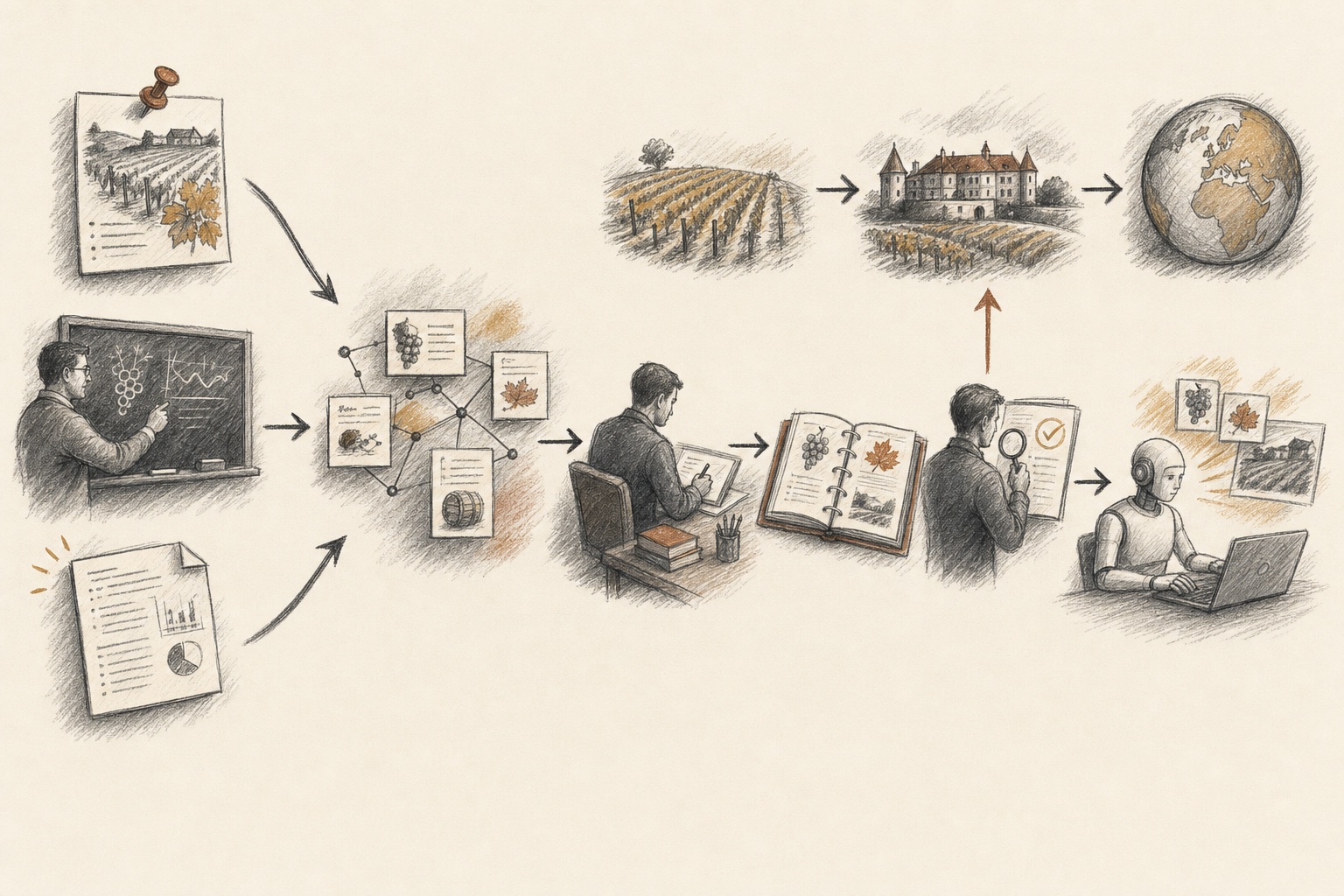
Scopes · vigne → vignoble → global- Three capture paths —
/lessonpins a fact,/teachingrecords an explicit teaching session, and passive capture records a session observation. - Typed entities & relations — selected facts become named records connected by explicit relationships.
- Curate → wiki → human review — evidence becomes readable, git-tracked pages in a reviewable MR.
- Recall — approved, confidence-gated knowledge returns to working agents.
- Promotion — synthesized pages rise from vigne to vignoble to global; raw entities do not.
Teaching a fleet
Two explicit inputs let you teach, plus a passive safety net:
/lesson ✅
Pin, edit, or replace a high-value rule or fact in shared memory:
/lesson <text>                          # pin a new lesson
/lesson --edit                          # interactive picker — choose a lesson to edit
/lesson --edit --entity=<id>            # edit a specific lesson by entity id
/lesson --replace --entity=<id> <text>  # replace the text of a specific lesson
A lesson is stored with type: rule and confidence: 0.95. It is published to the
NATS memory pipeline (pinard.<vignoble>.memory.rules), where the memory
ingester upserts it directly into SurrealDB — no Engram HTTP call, no LLM extraction.
This makes lessons reliable and side-effect-free.
The lesson is also immediately injected into the active agent session as a new turn, so the agent acknowledges and applies the rule right away — no restart needed.
Lessons in SurrealDB auto-qualify for auto_serve in recall and are candidates for
promotion to a broader scope (below). Entity ids appear in /recall hit labels
(e.g. ref: entity:entity:abc123) and can be passed to --edit --entity= or
--replace --entity= directly.
Available in: conductor (/lesson) and vendangeur (/lesson).
/forget --entity=<id> ✅
Delete a pinned lesson by its SurrealDB entity id:
/forget --entity=<id> # prompts for confirmation, then deletes
Only lesson-provenance entities can be deleted via /forget — the ingester
refuses to delete LLM-extracted entities, preventing accidental data loss.
Entity ids appear in /recall hit labels; copy the id from there.
Available in: conductor (/forget) and vendangeur (/forget).
/teaching mode ✅
A mode, not a one-shot. While active, every exchange is captured as a
teaching-episode from which a runbook, procedure, or ontology edges are extracted.
Its lifecycle is explicit and safe:
- a visible banner (status-line indicator
📚 Teaching) while it is on, - turned off explicitly (
/teaching offor re-toggle) and - auto-off at session end — it never persists silently.
Retroactive capture modes let you include exchanges that happened before you thought to enable teaching:
| Variant | What it captures |
|---|---|
/teaching | Activate from now; does not go back |
/teaching --all | Publish the entire session history as a teaching episode, then activate |
/teaching --from <duration> | Publish the last N minutes (e.g. 30m, 1h), then activate |
/teaching off or re-toggle | Deactivate; session transcript flushed at session end |
At session end, if teaching is still active, the full transcript is published as a single episode for better extraction context.
Available in: conductor (/teaching) only — vendangeurs are task-scoped and do not
have a multi-turn session to teach from.
Passive capture ✅
Engram session summaries and curated mem_save observations are captured
automatically, so lessons are never purely manual. This is the part that runs today.
MR knowledge ingestion ✅
When a merge request is merged, the daemon automatically assembles a memory event and publishes it to the memory service. The service runs two extraction passes and stores durable entities in SurrealDB.
Pass 1 — description + issues (provenance mr)
The primary pass reads:
- MR title and description (the what was realized)
- Closing issues title and description (the intent context)
- File paths changed (stored in entity data, not embedded)
Extracted entity roles:
decision— a choice made and why (“chose X over Y because Z”)artifact— a durable structural fact the change establisheddiagnosis— a root cause paired with its fix (issue: cause → MR: fix)- Re-scope deltas — when the MR diverged from the issue’s stated intent
When there is no durable knowledge (trivial mechanical change, uncertain extraction), zero entities are written — that is a success, not a failure.
Pass 2 — review delta (provenance mr-review)
After Pass 1, the ingester scans the pre-filtered review discussion for net-new durable knowledge not already captured in Pass 1 entities. The LLM is given the Pass 1 results as context; it only emits an entity when it can justify why that entity is not covered and not already expressed. The default is zero entities — noise or chatter yields nothing.
Entities extracted here get provenance="mr-review" and a slightly lower confidence
than Pass 1 entities. They appear in recall with the label [artifact:mr-review · scope] (or decision:mr-review / diagnosis:mr-review).
Pass 2 does not re-extract what Pass 1 already found. Its primary value is capturing forward-looking constraints flagged by reviewers as “worth noting for the future” or “not blocking this MR but must hold in a later change” — knowledge that would otherwise live only in the review thread.
@memory: review marker
Instead of waiting for LLM classification, a reviewer can pin a fact directly by
prefixing a review note with @memory: (case-insensitive):
@memory: always split the CA bundle into a per-component secret; sharing one secret across pods causes Vault rate-limit spikes
The daemon intercepts this marker immediately during review forwarding and routes
the note body straight into the /lesson pipeline — no Pass 2 LLM call, no
ambiguity. The same extraction runs in aoc mr-memory replay (see CLI
Reference).
Noise filter
Noise filter: The daemon skips MRs that are unlikely to contain decisions:
sync Ledger,bump-image,bump-charttitle prefixes^Revertprefixes- Cuvée accumulation merges (source branch starts with
cuvee/) - Empty or template descriptions
Override with labels on the MR:
| Label | Effect |
|---|---|
memory:skip | Never ingest this MR, regardless of content |
memory:capture | Always ingest, bypassing all noise filters |
In recall, Pass 1 entities carry a [decision:mr · scope] label (or [artifact:mr · scope] / [diagnosis:mr · scope]). Pass 2 review entities carry [decision:mr-review · scope]. Both expose url and files_changed when fetched in detail.
The self-evolving wiki ✅
The wiki keeps two representations in sync:
- OKF markdown (
wiki/in the vignoble repo) is the human-facing, git-tracked, durable artifact — still readable if everything else disappears. It follows the Open Knowledge Format (OKF) with YAML frontmatter (type,title,relations, etc.). - SurrealDB is the index, curation workspace, and serving layer: pages as
wiki_docdocuments, page embeddings as vectors, backlinks and typed entity references as graph edges — so the wiki is searchable through the same recall path.
OKF bundle scaffold
When the daemon starts for a vignoble, it calls EnsureBundle, which
idempotently seeds three reserved files under <vignoble>/wiki/:
| File | Purpose |
|---|---|
index.md | Root index listing the bundle |
INSTRUCTIONS.md | Wiki constitution: type vocabulary, folder conventions, contribution rules |
log.md | Change history |
The scaffold is committed to the vignoble repo automatically (best-effort). After
the initial seed, the daemon does not write to wiki/ again — all further content
comes from the curator.
WikiCurator (outbound — SurrealDB → wiki)
The WikiCurator reads the ontology-typed SurrealDB graph for a group_id,
clusters related entities and edges into concept candidates, and synthesizes OKF
markdown pages via the configured LLM. It runs every 6 hours inside the memory
service pod.
Key behaviors:
- Incremental — tracks a
wiki_curator_cursor; only re-synthesizes concepts whose underlying graph entities changed since the last run. The cursor is only advanced when synthesis succeeds — if the chat-LLM is unavailable, the curator does nothing and leaves the cursor in place so those entities are retried on the next cycle. - Full-snapshot curator MRs — each curator MR is a complete snapshot of all
auto_servewiki pages for the scope, not just the pages synthesized this cycle. This prevents a pod restart (which might find only one changed entity) from collapsing a large, previously-synthesized wiki into a single-page MR. Stale pages that are no longer backed by any live entity are pruned from the branch automatically. - No-fallback synthesis — a wiki page is written only when the LLM returns a non-empty title and body. If the LLM is unreachable or returns nothing usable, the entity is retried next cycle. No degraded placeholder pages are ever written.
- Scaffold entity guard — entities whose names are bare mem_save structured-body
markers (
What:,Why:,Where:,Learned:, and similar) are only skipped when their description is also trivial. Real observations starting with**What**:but carrying actual content are still curated (the LLM cleans their titles). - Deduplication — cosine similarity scan using the synthesized title’s
embedding prevents near-duplicate pages; close matches are updated in place rather
than creating a new page. Thresholds are role-aware: prose-heavy types (
decision,diagnosis) use 0.88; all others use 0.92. - Human-authored pages are protected — any page with
source: humanin its frontmatter is never overwritten or deleted by the curator. - Reserved files (
index.md,log.md) are always skipped. - Per-vigne namespacing — each vigne writes to
wiki/<vigne-name>/so vignes are isolated; a human edit to one vigne’s page only affects that vigne’s scope. - LLM-synthesized titles and summaries — the curator requests structured JSON
{title, summary, body}from the LLM; thesummaryfield is stored in SurrealDB and used in boot manifests (see Boot injection).
The curator writes pages as a branch + MR in the wiki git repo so all changes are human-reviewable before landing.
WikiSyncer (inbound — wiki → SurrealDB)
Editing a wiki page by hand and letting the curator refine it are the same loop. The
WikiSyncer pulls the wiki repo, diffs changed OKF files, and upserts them into
SurrealDB with embeddings and typed link edges.
- Idempotent via
content_hash— unchanged files are skipped. - Loop-safe — never writes back to git (inbound only).
- Runs every 6 hours, after each curator run.
Multi-vignoble curator
The memory service can curate multiple vignobles in one pod. Set
VIGNOBLES_BASE_DIR to the parent directory of cloned vignoble repos (each
subdir named vignoble-<name>/ containing a vignes.yaml). The curator and
rollup engine iterate all discovered vignobles automatically — no per-vignoble
configuration is needed.
Confidence gating ✅
Wiki pages are confidence-gated before being served in agent recall. Each page carries a confidence score derived from how many ontology-typed entities back it and how well-typed those entities are:
- ≥ 0.7 →
auto_serve— included in agent recall automatically. - < 0.7 →
needs_review— held back from recall until a human reviews and promotes the page.
The score is computed from a base of 0.60, a cluster-size bonus (more corroborating
entities → higher confidence), and a role bonus for high-signal types (decision,
diagnosis, verdict, log_pattern each add +0.12). A single well-typed decision
or diagnosis entity therefore reaches auto_serve on its own; artifact-typed pages
need more corroboration.
In practice, when an agent issues a recall query, the memory service blends wiki
hits (vector + keyword) with entity-graph hits, deduplicates them by session, and
summarizes all auto_serve wiki pages alongside entity results in the [memory]
context block.
Ontology gardener ✅
The OntologyGardener mines the entity_staging and edge_staging tables for
a group_id, clusters proposals that didn’t match any existing ontology type, and
applies LLM-driven Map / Extend / Hold decisions per cluster:
| Decision | Meaning |
|---|---|
| Map | The proposal maps to an existing type — no ontology change needed |
| Extend | A genuinely new type is warranted — emit a human-gated MR |
| Hold | Not enough signal yet — wait for more recurrences |
For Extend decisions, the gardener writes an ontology-proposals/<id>.yaml
file into the wiki repo and opens an MR there. The MR includes a copy-paste Python
snippet for register_domain(...) — a human approves the proposal and manually
applies it to the pinard source repo. The ontology is never mutated automatically.
The gardener runs inside the same memory-service pod as the curator, on a periodic schedule driven by the ingester.
Scope & promotion ✅
Knowledge is stored at the finest grain (a vigne) and rolled up by the
memory service, which knows vignoble membership from vignes.yaml:
vigne ──▶ vignoble ──▶ cross-vignoble (global)
Curate-on-promote (invariant)
Only synthesized wiki_doc entries rise. Raw entities (
artifact) and typed entities never copy upward verbatim.
When the rollup engine detects cross-vigne overlap — recurring wiki pages or typed
entities that appear in multiple vignes — it synthesizes a new consolidated
wiki_doc at the vignoble or global scope via the configured LLM, rather than
copying raw content. The promoted page gets an LLM-synthesized title, one-line
summary, and body. Raw artifact entities are excluded entirely and never rise.
Curate-on-promote results (vignoble-scoped wiki_doc rows) are also synced to
wiki/_shared/ in the wiki git repo (branch wiki-curator/_shared, MR opened for
review), so operators can see the cross-vigne synthesized knowledge in one place.
Note: Directly-ingested Engram observations — captured by the conductor, régisseur, or maître under a vignoble-scoped project — are preserved across rollup cycles. Only entities introduced by the old promotion path (
provenance = 'promotion') are cleaned up during rollup. Prior to v0.32.2, the rollup engine incorrectly deleted all entity rows at the vignoble scope on each cycle, silently erasing these memories; that bug is now fixed.
Per-vigne wiki namespacing
Each vigne’s curator writes to its own subdirectory: wiki/<vigne-name>/. A human
edit to one vigne’s page is only ingested into that vigne’s SurrealDB scope, not
others.
A fact that recurs across many scopes
A fact that recurs — e.g. the same commit-prefix rule seen in several vignobles — becomes a promotion candidate toward a broader scope, up to and including the base prompt every agent inherits.
The unifying insight: scope roll-up, cross-scope rule promotion, and ontology
promotion (domain → core) are the same pattern — recurrence detection plus review.
Engram’s relation-judgment tools (related / scoped / supersedes /
conflicts_with) are the candidate engine for detecting recurrence and
contradiction, rather than a custom build.
Human-gated by design
Anything that mutates global agent behavior — most of all the base prompt — is human-gated: a wrong global rule would misbehave every agent at once. Promotion reviews surface where humans already work: as checkboxes or forms in the Obsidian wiki that translate an approval into a git PR — low-friction review, full audit trail.
Admin flags
The memory ingester (cmd/memory-ingester) exposes admin flags for recovery and
maintenance. Each flag causes the ingester to perform the operation and exit
immediately, without running the normal ingestion loop:
| Flag | Purpose |
|---|---|
--reingest | Reset all ingest cursors to seq=0 so the next startup re-reads every Engram observation and re-derives entity roles from scratch. Use after a type_map change to re-type an existing corpus. |
--recurate | Delete all non-human wiki_doc rows and drop wiki_curator_cursor tables across every scope (vignes, vignoble-*, __global__, and the current parcelle if set). The next startup regenerates all wiki pages cleanly. Use after a curator or rollup change that alters wiki output and would otherwise be blocked by stale rows. |
--rechunk | Backfill wiki_chunk rows for all existing wiki_doc pages across every scope, then exit. Idempotent — safe to re-run. Use after a chunking strategy or embedding-model change to rebuild the per-heading chunk index used by semantic recall. |
# In the memory-ingester pod (exec in or via kubectl run):
memory-ingester --recurate    # wipe stale wiki pages; curator regenerates cleanly
memory-ingester --reingest    # re-ingest all observations and re-derive entity types
memory-ingester --rechunk     # rebuild per-heading wiki chunk embeddings
Note:
--recuratedeletes all auto-generated wiki_doc rows across all scopes. Human-authored pages (source: humanin frontmatter) are not affected. The operation is immediate — run it only when you want the curator to rebuild the entire wiki from the current entity graph on its next cycle.
Next
- The Ontology & Portable Memory — how promoted types and rules are typed and shipped.
- The Layered Memory Architecture — the full stack.