Overview
Pinard is a distributed engine for orchestrating fleets of LLM agents through semi-deterministic loops — deterministic runbooks that drive non-deterministic agents, coordinated over NATS across many repositories and machines.
One conductor. Many agents. One harvest.
The idea
A raw LLM agent is powerful but unpredictable: it wanders, forgets, and can’t be resumed. Pinard wraps each agent in a semi-deterministic loop — a defined sequence of steps where the control flow is deterministic code and only the work inside a step is left to the model. The result is agent work that is
- reliable — the loop decides what happens next, not a hopeful prompt;
- resumable — every step is journaled, so a crashed run picks up where it left off;
- auditable — you can read exactly which steps ran and why;
- distributed — loops run as agents spread across repos and machines, coordinated over NATS.
Three pillars hold it up:
Deterministic control (the loop) · Non-deterministic agents (the model) · Persistent memory (recall across sessions)
Automating code review — turning GitLab issues into merged MRs — is just one built-in loop. It is an application of the engine, not the engine itself.
The mental model
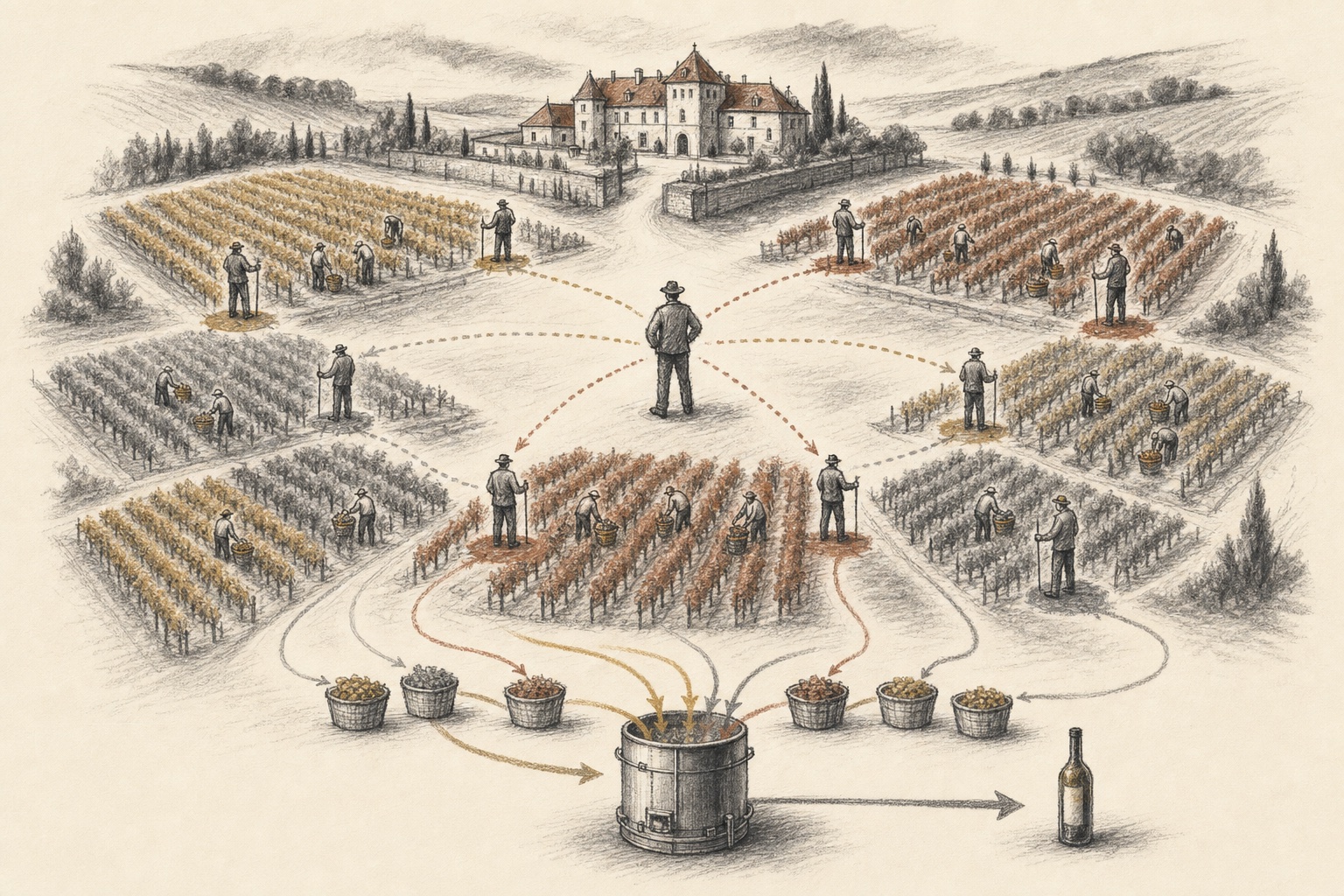
Pinard borrows its vocabulary from winemaking. Everything below is a role or a place in the estate:
 Vignoble
Vigne · repository
Parcelle · outlined workstream
Régisseur
Maître
Vendangeurs · workers
Cuvée
Vignoble
Vigne · repository
Parcelle · outlined workstream
Régisseur
Maître
Vendangeurs · workers
Cuvée
main- Vignoble / vigne / parcelle — workspace, repository, and persistent workstream.
- Régisseur / maître / vendangeur — estate conductor, workstream conductor, and task worker.
- Cuvée →
main— several worker branches blend before one final merge.
| Term | Meaning |
|---|---|
| Vignoble | A workspace (an “estate”) — one directory that groups the repos and workstreams you orchestrate. |
| Vigne | A single repository (“vine”) registered in the vignoble. |
| Parcelle | A named, persistent workstream — a plot of related work that spans many tasks, agents, and days. |
| Cuvée | An intermediate branch that batches several agents’ outputs before they reach main. |
| Régisseur | The estate manager — the top-level conductor for the whole vignoble. |
| Maître | A parcelle-scoped conductor — one per active parcelle. |
| Vendangeur 🧺 | A harvester — a worker agent that runs one loop to completion, then is reaped. |
A note on “worker” vs “vendangeur”. User-facing surfaces (dashboards, status lines, tool labels) call the harvester a vendangeur. The code keeps the name worker — CLI flags (
--worker), env vars, tool names (list_workers), config keys. When these docs describe CLI or code they say worker; when they describe what you see they say vendangeur.
The pieces
Pinard is a handful of cooperating processes that talk exclusively over NATS
JetStream (wss://) — never direct HTTP between components.
- Daemon (
aoc daemon) — the always-on engine. Watches events, evaluates schedules, auto-spawns agents, dispatches work to running loops, and owns the per-vignoble memory serve. It runs without any LLM and is the part that must always be up. - Régisseur & maîtres — optional, LLM-powered conductors (Opus) that give you a conversational way to steer. The system functions without them; they add orchestration and interaction.
- Vendangeurs (workers) — agents (Sonnet) that each run one semi-deterministic loop — often in an isolated git worktree — and are cleaned up when done.
- CLI (
aoc) — the Go binary that scaffolds vignobles, spawns agents, runs the daemon, and exposes everything else.
How work flows
At the core, every unit of work is a loop run by an agent:
- A trigger arrives — a schedule fires, an event is published, or you (or a conductor) start a task.
- The daemon spawns a vendangeur running the appropriate babysitter process (the loop definition) with a stable run id.
- The loop advances step by step — each step is deterministic code or a bounded LLM turn — journaling its state as it goes.
- If the agent crashes or the host reboots, the run resumes from its journal.
- What the agent learns is written to memory, so the fleet improves over time.
- When the loop completes, the vendangeur is reaped.
The SWE process is the reference loop: issue → change → MR → merge. But you write your own loops for whatever your fleet does.
Where to go next
- The Semi-Deterministic Loop — the core concept.
- Getting Started — install and run your first loop.
- Architecture — the engine internals.
- Memory & Recall — how the fleet remembers and improves.