Distributed & Remote Execution
A vendangeur doesn’t have to run on the Pinard host. Because every component talks only over NATS, a worker can run on a different machine that has no vignoble directory at all — for example an HPC node inside a Singularity sandbox — and still be driven by the vignoble’s conductor.
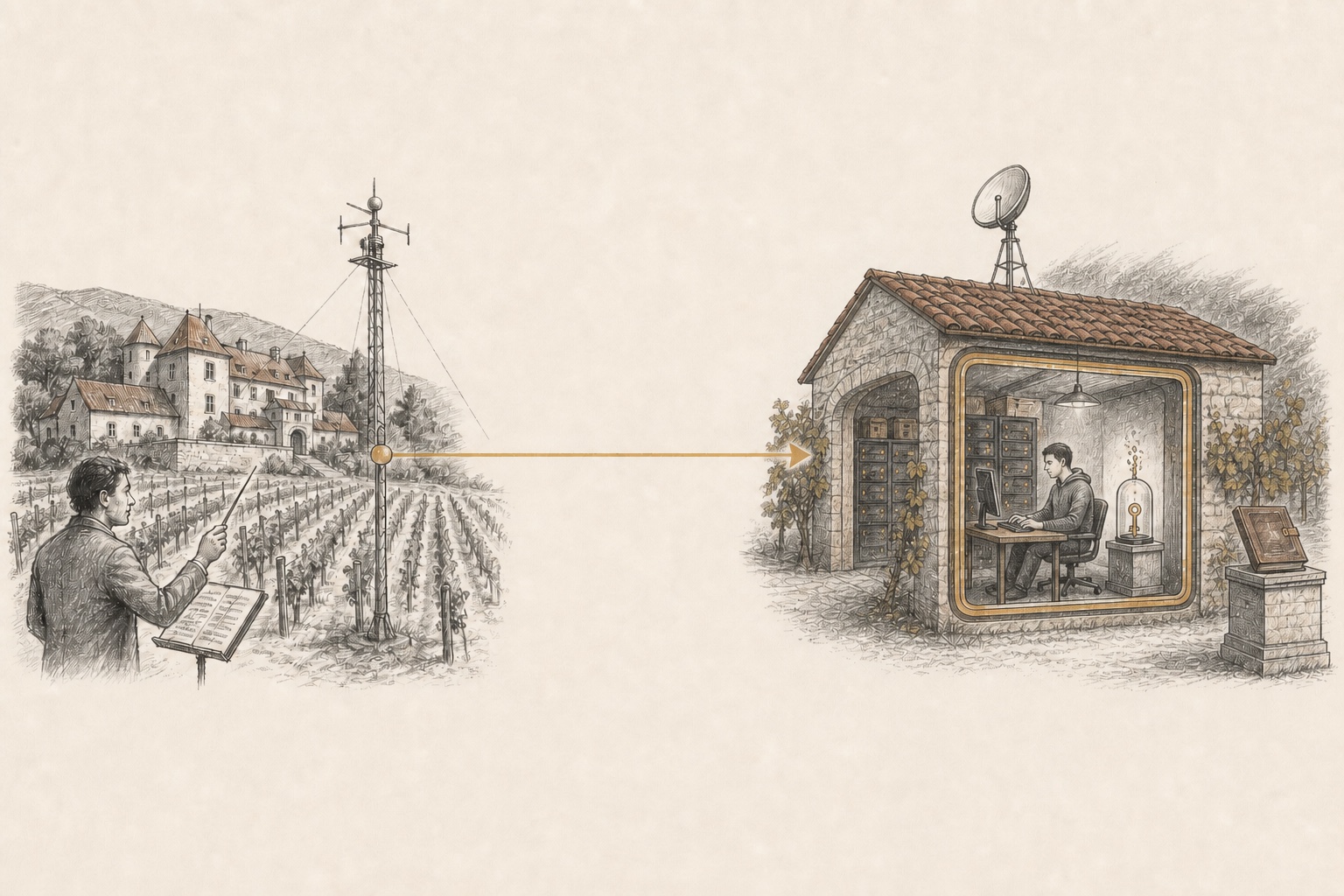 Pinard host
→ · Outbound NATS
K · Secrets stored in RAM
J · Run journal
▣ · Responder on isolated remote host
Pinard host
→ · Outbound NATS
K · Secrets stored in RAM
J · Run journal
▣ · Responder on isolated remote host- →NATS namespace identifies the vignoble without requiring its directory.
- JStable run ID + bound runs directory make restart and resume possible.
- KUncork/pour credentials are written into ephemeral RAM and vanish at stop.
- ▣Web-terminal responder provides observation without opening inbound SSH.
Launch
Identify the vignoble by name (the NATS namespace) instead of a path:
pinard --worker --vignoble-name myproject --model <concrete-model-id> --args '<json>'
With --vignoble-name, the launcher skips all vignoble-directory resolution and
$VIGNOBLE-derived setup. Because model resolution normally needs the vignoble, a
standalone worker must pass a concrete --model <id>.
Where config comes from
| Concern | Source |
|---|---|
| NATS credentials | ~/.config/pinard/credentials.yaml (via aoc env-exports) — not the vignoble |
| NATS namespace | --vignoble-name |
| Babysitter process | Baked into the project repo at pinard/<proc>/process.js (override with PINARD_PROCESS_FILE) |
| Process inputs | --args '<json>', or synthesized with the vignoble-free aoc vigne-args --repo <group/proj> … |
Resuming after failure
Babysitter resumes a run from <runs-dir>/<RUN_ID>/run.json, so a remote worker needs
two things to survive a restart:
- a stable
RUN_ID(defaults to<project>-<process>, not the PID-based session name), and - a persistent
--runs-diron a bound path.
Re-running with the same RUN_ID continues where it left off. Note that environment
variables don’t cross singularity --containall, so pass --runs-dir as an argument
(not an env var), pointing at a persistent, bound directory. Daemon-side orphan recovery
does not manage remote runs.
Persistent pi session
When BABYSITTER_RUNS_DIR and BABYSITTER_RUN_ID are set (which aoc spawn --runtime singularity does automatically), the launcher saves the worker’s pi conversation log
under the run directory:
<BABYSITTER_RUNS_DIR>/<BABYSITTER_RUN_ID>/pi-session.jsonl
Because the run directory is on a bound, persistent path, the session transcript
survives container restarts and is visible off-host. A resumed run (same RUN_ID) also
continues the same pi conversation. The path is logged to stderr at startup. If the run
directory is unknown, the worker falls back to pi’s default (~/.pi/agent/).
Standalone engram
Standalone workers (pinard --vignoble-name …) have no daemon to own an engram serve.
The launcher starts its own engram serve on the computed port (derived from the
vignoble name: cksum(name) % 1000 + 7500) and sets ENGRAM_URL so the standard
health gate applies. If the serve is already healthy (e.g. a persistent container
reuse), the spawn is skipped. The engram binary must be available on PATH — the
launcher exits with a clear error if it is not.
Cloud sync follows the same periodic-flush loop as any other worker.
Process file override
By default the launcher resolves the babysitter process definition from the project repo
(pinard/<proc>/process.js) or the vignoble. Set PINARD_PROCESS_FILE to an absolute
path of an existing file to skip that search entirely and use the given file instead:
export PINARD_PROCESS_FILE=/opt/pinard/processes/my-build.js
pinard --worker --vignoble-name myproject --process my-build …
This is useful when:
- The process is baked into a container image at a fixed path.
- You want to iterate on a local copy without touching the repo checkout.
If PINARD_PROCESS_FILE is unset or points at a missing file, the search falls through
to the normal lookup order. The resolved path (and whether the override was applied) is
logged to stderr on startup.
Sandboxed bootstrap
When a worker runs with --containall in a Singularity sandbox, the container’s $HOME
starts empty — there are no bind-mounted credential files. Credential bootstrap lets the
image obtain its secrets at startup from revocable URLs, so the image itself never contains
any credentials.
Two env vars drive the bootstrap, both passed in by aoc spawn --runtime singularity (or by
the operator directly) and consumed by the image’s runscript (via dist/singularity/run-worker.sh):
| Env var | Purpose |
|---|---|
PINARD_UNCORK_URL | URL of the shared credential bundle (NATS creds, credentials.yaml, …) |
PINARD_POUR_URL | URL that mints a per-operator LLM token (the pi proxy credential) |
What happens at startup
When PINARD_UNCORK_URL is set, the generic runscript does three things before the worker starts:
1. aoc uncork --url $PINARD_UNCORK_URL     # write shared creds under $HOME
2. aoc ensure-proxy-provider               # seed ~/.pi/agent/{models,auth}.json
3. exec pinard --worker …                  # start the worker
When PINARD_UNCORK_URL is not set, the legacy bind-mount path is used (step 3 only).
RAM-only secrets
The container always runs with --containall --writable-tmpfs, so the ephemeral $HOME
lives entirely in RAM. Secrets written by aoc uncork never touch the host filesystem;
they vanish when the container stops.
LLM token (pour)
PINARD_POUR_URL points at an endpoint that returns a short-lived LLM token (JSON or a bare
string). Two operators can share the same PINARD_UNCORK_URL but each supply their own
PINARD_POUR_URL, so revoking one URL disables only that operator’s sessions.
The proxy provider is now registered directly from env vars baked into the container
image, without requiring ~/.claude/settings.json:
| Env var | Purpose |
|---|---|
PINARD_PROXY_BASE_URL | Anthropic proxy endpoint (baked into the image) |
PINARD_PROXY_HEADERS | Extra HTTP headers for the proxy (e.g., Auth-Type: bedrock) |
PINARD_POUR_URL | URL that returns a short-lived LLM token; read at startup |
These are read by the Pi extension directly from the process environment. Hosts that
already have ~/.claude/settings.json continue to work unchanged (settings.json wins).
aoc ensure-proxy-provider (the explicit bootstrap step) remains available for images
that prefer to pre-seed ~/.pi/agent/{models,auth}.json before the worker starts.
Minting a bundle URL
Use the mint-uncork-url Pi skill (available to the conductor) to create or rotate a
bundle stored in Mnemosyne. The skill generates a time-limited signed URL and captures the
admin /view link for auditing.
Missing bind sources
aoc spawn --runtime singularity now skips any --bind entry whose host source path
doesn’t exist (warns instead of aborting), so optional bind mounts (e.g., cert directories
that only exist on some cluster nodes) can be declared in vignes.yaml without failing
the launch on nodes that lack them.
Auto-mirroring in the control room
The daemon automatically creates local tmux mirror sessions for agents that are
running on remote hosts. Every 30 seconds it checks the pinard-agents KV for
agents whose session is absent from the local tmux socket; for each such agent it
spawns a tmux new-session running aoc attach <name> so you can see remote
vendangeurs in tmux ls without manually running aoc attach per agent.
Mirrors are torn down automatically when the KV entry disappears or the agent
reaches a terminal state (stopped, completed, failed). If aoc attach exits
while the agent is still listed as live in KV, the mirror is respawned.
This means remote agents appear alongside local agents in the conductor control room without any manual setup.
Remote worker liveness in the conductor
The conductor’s worker list (list_workers, the dashboard, aoc status) tracks
remote/standalone workers by KV heartbeat, not by local tmux presence. A remote
worker’s KV entry is only considered stale when its lastSeen heartbeat is more than
5 minutes old — matching the webterm gateway’s own threshold. The conductor never
deletes a remote worker’s entry simply because the session is absent from the local
tmux socket (that was the root cause of “remote worker not appearing in the dashboard”
errors; this behaviour was corrected).
Local workers continue to use the local-tmux liveness check as before.
Watching a remote worker
For daemon-less or Singularity workers that have no tmux available, the launcher
automatically starts aoc webterm-worker-responder — a PTY responder that bridges
the worker’s own controlling terminal over NATS using the same grant-gated protocol
as the tmux-backed responder. No tmux, no extra process: the worker’s own PTY
becomes the viewable/steerable terminal.
For workers with tmux, run aoc webterm-responder on the remote host. In both
cases use the Web Terminal to watch from a browser — no SSH
required.