The Semi-Deterministic Loop
The semi-deterministic loop is Pinard’s core idea. It is what turns a capable but unpredictable LLM agent into a reliable, resumable, auditable unit of work.
Deterministic control, non-deterministic work
A free-running agent is handed a goal and a pile of tools and left to figure out the path. That is flexible but fragile: it wanders, repeats itself, can’t be resumed after a crash, and gives you no honest account of what it did.
A semi-deterministic loop inverts the balance. You define the path — an explicit sequence of steps — as ordinary code. The model is only invoked inside a step, to do the one bounded thing that genuinely needs judgment:
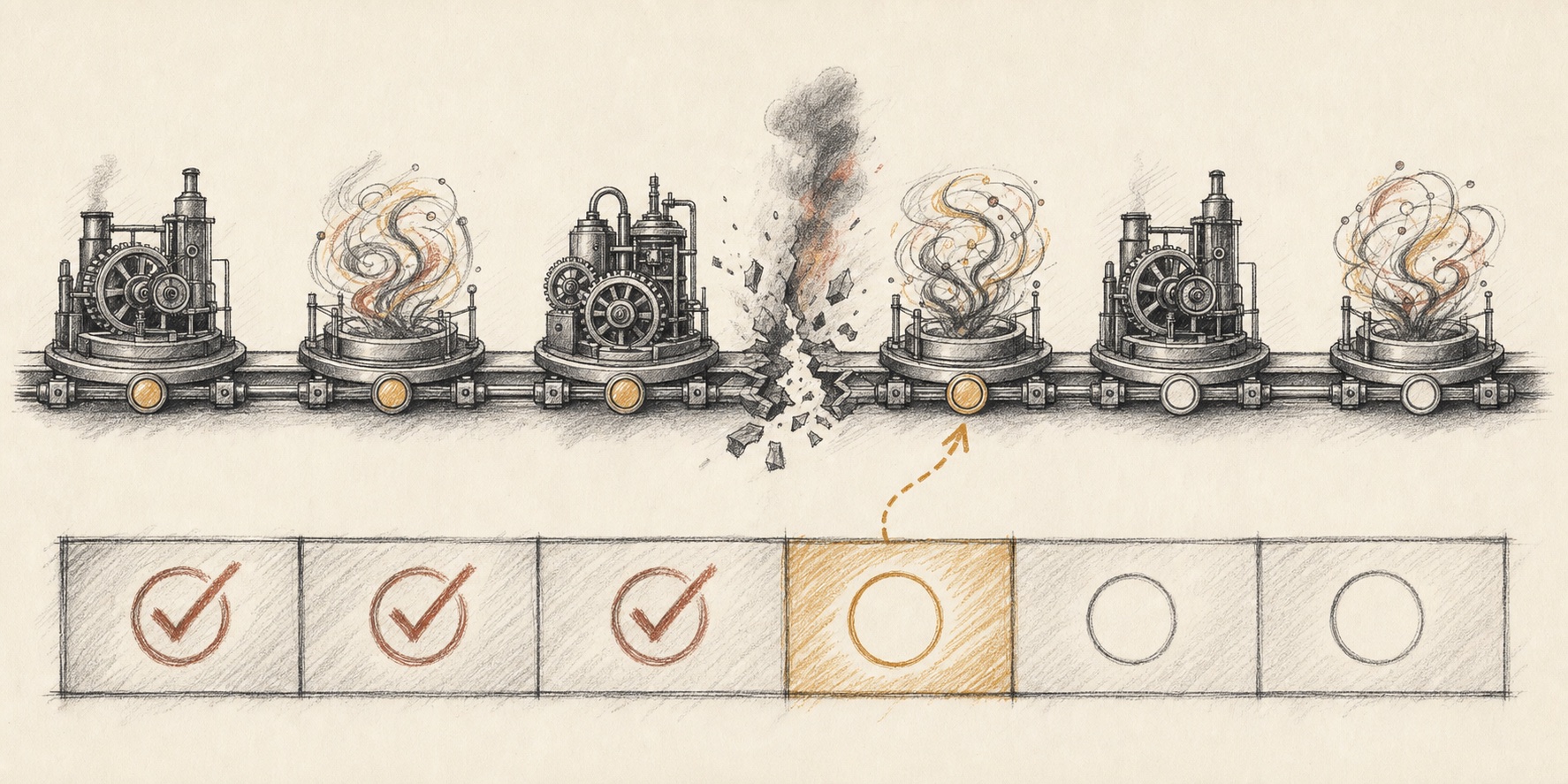 1 · Code step
2 · LLM turn
3 · Code step
4 · LLM turn
5 · Code step
6 · LLM turn
Crash after step 3
Journal: steps 1–3 complete
Resume at step 4
1 · Code step
2 · LLM turn
3 · Code step
4 · LLM turn
5 · Code step
6 · LLM turn
Crash after step 3
Journal: steps 1–3 complete
Resume at step 4- Code steps — deterministic code owns sequencing, branching, and stopping.
- LLM turn — the model supplies bounded judgment only inside a declared step.
- Journaled outcomes — completed tasks and breakpoint decisions survive interruption.
- Crash → resume — replay skips completed work and continues at the next incomplete step.
The control flow is deterministic — the loop decides what runs next and when to stop. The work inside a step may be non-deterministic — the model’s turn. Hence semi-deterministic.
The babysitter
The component that runs a loop is the babysitter. A loop is defined by a
babysitter process — a process.js file that lists the steps and their logic.
The babysitter:
- drives the agent step by step, invoking the model only where the process says to;
- journals every step and its outcome to a per-run directory;
- resumes an interrupted run from that journal;
- enforces gates (breakpoints) where the loop pauses for a verdict or a human;
- records verdicts and decisions so the run is auditable after the fact.
A process lives with the code it operates on — baked into a repo at
pinard/<process>/process.js — so the loop is versioned alongside the thing it
automates. See Authoring Processes to write one.
Runs, journals, and resume
Every execution of a process is a run, identified by a stable run id. The babysitter writes a journal under a runs directory keyed by that id:
<runs-dir>/<run-id>/
  run.json          # the run's step-by-step state
  pi-session.jsonl  # the agent's session transcript
Because the run id is stable, re-invoking the process resumes the same run — the engine rebuilds its state from the journal and continues from the next incomplete step. A crashed agent, a rebooted host, or a multi-day pipeline all pick up exactly where they left off, rather than starting over.
Rebuilding state from the journal on resume is routine — the engine reconstructs and continues. It is not an error.
Why it matters
| Free-running agent | Semi-deterministic loop |
|---|---|
| Path decided by the model, per run | Path decided by code, every run |
| Non-resumable — a crash loses everything | Resumable from the journal |
| Opaque — “what did it do?” | Auditable — read the steps and verdicts |
| Unbounded — may wander or loop | Bounded — the loop decides when to stop |
| Hard to distribute reliably | A unit you can spawn, retry, and recover |
This is what makes it safe to run fleets of agents across many repos and machines: each one is a bounded, recoverable loop rather than an open-ended chat.
Where loops run
A loop is executed by a vendangeur (worker) — usually spawned by the daemon in its own git worktree, but it can also run standalone on remote hardware (an HPC node, a SLURM job) with no daemon at all. Either way it talks to the vignoble over NATS and resumes from its journal. See Distributed & Remote Execution.
Next
- Authoring Processes — write your own loop.
- Architecture — how the babysitter fits the engine.
- The SWE Process — the reference loop, end to end.